
| TYPE | DIMENSIONS | |
|---|---|---|
| 3-Bow Round Tube | 36"H x 67-72"W x 6'L | Select Size |
| 3-Bow Round Tube | 46"H x 73-78"W x 6'L | Select Size |
| 3-Bow Round Tube | 54"H x 79-84"W x 6'L | Select Size |
| 3-Bow Round Tube | 54"H x 85-90"W x 6'L | Select Size |
| 4-Bow Round Tube | 54"H x 91-96"W x 8'L | Select Size |
| 3-Bow Round Tube | 60"H x 79-84"W x 6'L | Select Size |
| 4-Bow Square Tube | 48"H x 96-102"W x 8'L | Select Size |
| 4-Bow Square Tube | 48"H x 96-102"W x 9'L | Select Size |
| 4-Bow Square Tube | 48"H x 96-102"W x 10'L | Select Size |
| 4-Bow Square Tube | 48"H x 96-102"W x 16'L | Select Size |
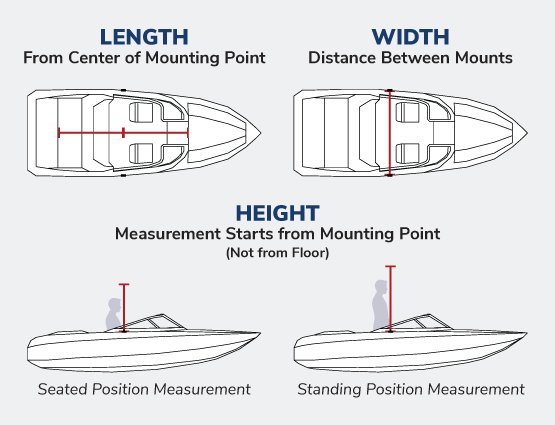
Determine which portion of your boat you want the Bimini top to provide shade, then measure this area front to back and identify the center point for coverage, typically over the cockpit or seating area.
Using the center point of coverage at your ideal mounting locations, simply measure straight across (horizontal width) between these two points. The center of the frame will attach to the boat at these locations.
Height is determined by measuring the distance from the mounting point (not from the floor) to a height that will give you enough headroom for your intended use. If you primarily sit, then measure from a seated position. If you intend to stand often, then measure from a standing position.
Full Measuring Instructions
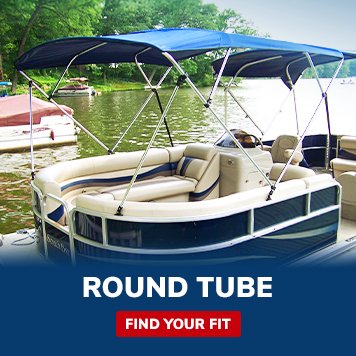

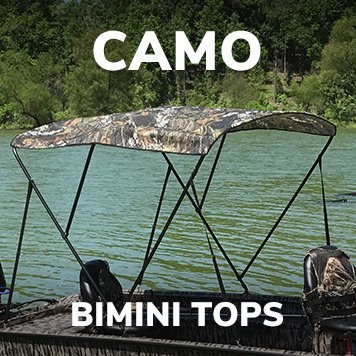
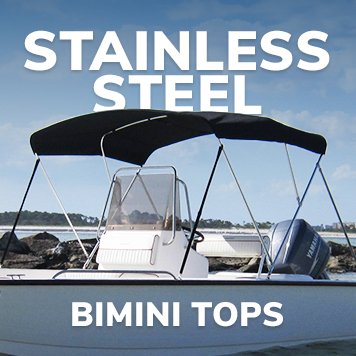
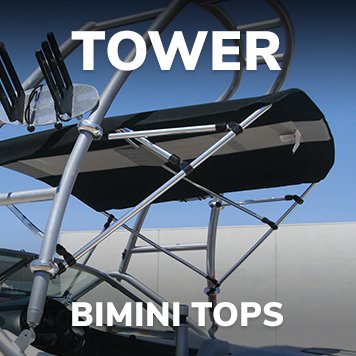
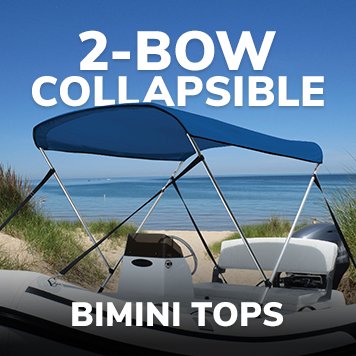
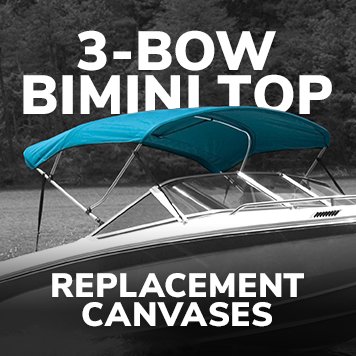
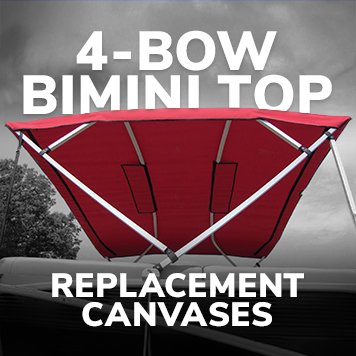
Finding the right bimini top by dimensions is one of the easiest ways to get a clean, secure fit without needing your exact boat make and model. At the top of this page, you will choose a height + length combination and then select your width range. The key is understanding how those measurements translate to real use on the water. This guide applies to boats without a ski or wakeboard tower. If your boat has a tower installed, they will require separate measuring instructions for Universal Tower Bimini Tops
If you are wondering “what size bimini top do I need?” or “how do I measure for a bimini top?”, here is how to get it right.
Length is the portion of your boat you want the Bimini top to cover (front to back). Start by deciding how much of your boat you want to be shaded. The tops are available in 5’, 5’6”, 6’, 8’, 9’, 10’ and 16’ lengths.
Use these general ranges as a guide:
A helpful tip: sit in your boat and look at where people typically sit. Your bimini top should cover that primary seating zone. If you entertain or move around a lot, leaning toward more coverage is usually the better choice.
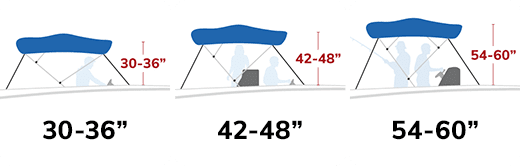
Height determines your headroom and how much shade the top provides. This measurement is taken vertically from the mounting point straight up, not from the floor.
We have a wide range of Bimini top height options to accommodate virtually all boating needs including: 30”, 35”, 36” 42”, 46”, 48”, 54” and 60”.
Use these ranges as a guide:
A helpful tip: Always measure from where the frame will attach to the boat. If measured from the floor instead of the mounting point, you will end up with a top that is too tall. The higher the top, the more opportunity sunlight has to enter the seating areas. Choose a height that provides a balance of what you need to be comfortable with. Note that our 46”H tops may be cut down to a lower 36”H and the 35”H Super Sport tops may be cut down to a lower 30”H for more flexibility (see instructions).
Our bimini top frames are designed with a slight curvature or crown and will not be completely flat. There is more space at the crown. Example a 36”H top may measure 38”H or so in the center depending on installation factors. This information is important for consideration only if you are installing the bimini top underneath a structure (such as the boom on a sailboat for example).
Width is the most important measurement for a proper fit on your boat.
This measurement is your mounting width, not the overall beam of your boat.
Once you have that number, simply choose the width range that your measurement fits in between.
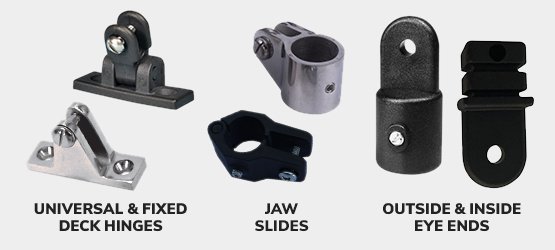
All mounting hardware is included with our tops for standard mounting applications. This includes universal deck hinges with 90 degree stops to allow mounting in virtually any position. Specialty deck hinges are available for curved rails and inflatable boats mounts.
A helpful tip: if you are between two ranges, it is usually better to stay within the recommended range rather than sizing up too far, as that can affect fit and stability.
We have a wide range of mounting width options from 47” and 102” and everything in between to accommodate virtually all boating needs. If in doubt, select mounting points that offer sturdy support and symmetrical placement or contact us for help.
Before finalizing your selection, take a quick look at your mounting area:
This step is especially important if you are installing a bimini top for the first time.
Here is how most boaters align their measurements with how they use their boat:
To find the best bimini top by dimensions:
Taking a few extra minutes to measure correctly ensures your bimini top fits right, installs easily, and performs the way it should.
If you want additional guidance, detailed instructions, or visual walkthroughs, check out these helpful resources:
Still have questions? Our team is here to help you get the right fit.
Online: Submit a Request
Phone: (855) 701-7017
You can also visit our Help Center for detailed guides and support.